

Workflow Benefits
CPOE offers the benefit of reducing steps from order composition to pharmacist verification. This reduction in steps allows for fewer people to be involved in order fulfillment. Fewer steps and fewer people involved leads to fewer opportunities for mistakes and increased efficiency in delivery.
In 2000 the Institute of Medicine releases the landmark report “To err is Human”.4 This report shows the seriousness of medical errors and called for ways to control the human element. The fewer hands an order must pass through to fulfillment, the less chance for such errors to occur.
Before CPOE Deployment
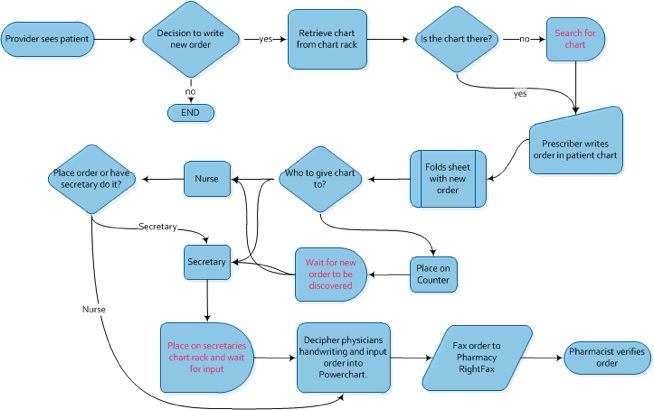
After (Proposed)

Decreased Waiting
CPOE has been shown to significantly decrease the time from order composition to pharmacist verification. The implementation of CPOE at a 761-bed tertiary care hospital reduced order processing time by 97%; the mean time was reduced from 115 minutes to just 3.2 This time savings would be a result partly of the elimination of waiting between every step of our current process. Additional time savings would result from less need for pharmacist correction of medication orders. What this means for your patient is that they will get the treatment they need, when they need it.
Increased Accuracy
Clinical Decision Support (CDS) is a built in resource to help providers order the most appropriate treatment for their patients. A recent study in the Annals of Internal Medicine showed that CDS had a positive impact on ordering recommended treatments, clinical studies and preventive services.3 The reduction in handwritten communication will also help to ensure that your order is properly handled down the line. Most importantly, the criticism of your handwriting should drastically decrease!
Decreased Errors
A study was conducted at Brigham and Women’s Hospital in Boston to determine the effect CPOE had on medication error rates. During the four year study, which involved incrementally expanding CPOE and Decision Support, there was a significant decrease in medication errors. The non-missed-dose medication error rate fell 81%, from 142 errors per 1,000 patient days to 26.6. The non-intercepted serious medication error rate fell 86%.1
1.Bates, D. W., Teich, J. M., Lee, J., Seger, D., Kuperman, G. J., Ma'Luf, N., et al. (1999). The Impact of Computerized Physician Order Entry on Medication Error Prevention. Journal of the American Medical Informatics Association , 6 (4), 313-321.
2.Wietholter, J., Sitterson, S., & Allison, S. (2009). Effects of computerized prescriber order entry on pharmacy order-processing time. American Journal of Health-Sysytem Pharmacy , 66 (15), 1394-1398.
3.Bright, T. J., Wong, A., Dhurjati, R., Bristow, E., Bastian, L., Coeytaux, R. R., et al. (2012). Effect of Clinical Decision-Support Systems. Annals of Internal Medicine , 157 (1), 29-43.
4.Kohn, L. T. (2000). To Err Is Human : Building a Safer Health System. National Academy Press.
